Wednesday, January 22, 2020

Best Books of 2019 - Fiction


This is third of 3 yearly lists of the best books I read in 2019.  This post contains the best fiction books I read this year.

The Black Prism by Brent Weeks.  Brent Weeks’ Lightbringer series, of which The Black Prism is the first, is a wonderful addition to my collection of fantasy epics.  While it has the seemingly prototype clueless hero, it has a very unique power/magic system and wonderful world building.  With many story arcs and characters you either love or hate, Weeks’ books keep you coming back for more.  I am patiently waiting for the 5th and last book to come out in paperback.  The other titles in the Lightbringer series I read this year are:  The Blinding Knife, The Broken Eye and The Blood Mirror.

Empire of Glass by Tad Williams.  William’s series, Memory, Sorrow and Thorn, still remains one of my favorite fantasy series.  Empire of Glass is book 2 of a series set in the same world, but decades after the first trilogy.  This book picks up where book 1 ends and drives the various threads of the story along.  And, not surprisingly, Williams leaves you hanging at the end waiting for book 3.  GRRRR!

Tombland by C. J. Sansom.  This is another one of Sansom’s magnificent Shardlake historical mysteries.  Set in 1549 in England, after the death of Henry VIII and during the reign of his son Edward, lawyer Matthew Shardlake, while investigating a mystery, gets caught up in a peasant revolt against the ruling nobility.  The book is long and imposing looking – 866 pages! – but is well-paced and fascinating, both as a mystery and as history.


2nd Tier reads – good, recommended, just not up to the level of those above:
Fire and Blood by George R. R. Martin
Malice by John Gwynne
Outcasts of Order by L. E. Modesitt Jr.
The Death of Dulgath by Michael J. Sullivan
Twelve Kings in Sharakhai by Bradley P. Beaulieu
Deep Fathom by James Rollins

3rd Tier reads, somewhat disappointing:
Red Rising by Pierce Brown

Monday, January 13, 2020

Best Ministry-Related Books of 2019


This is the second of three blog articles about the best books I read in 2019.  This list is about the ministry-related books I read, which span from church history to theology to analysis on current cultural trends.

Love Thy Body:  Answering Hard Questions about Life and Sexuality by Nancy R. Pearcey.  Hands down the best ministry-related book I read last year.  Pearcey does what she claims in her title – she unmasks the evils of personhood theory and relates in stark, logical detail how a denial of our created body affects many areas of life, including abortion, sexuality, marriage and even parenting.  This should be required reading for any Christian serious about understanding our times.

Holy Sexuality and the Gospel:  Sex, Desire and Relationships Shaped by God’s Grand Story by Christopher Yuan.  I heard Dr. Yuan speak at Montana Bible College’s Pastors conference a few years back and was eagerly awaiting his book.  Yuan is a celibate, same-sex attracted believer who teaches at Moody Bible Institute.  His book speaks to same-sex attraction, marriage and singleness, as well as the need for all believers to find their primary identity in Christ above all else.

Union with Christ:  The Way to Know and Enjoy God by Rankin Wilbourne.  I read Union with Christ with my associate pastor and we both enjoyed it greatly.  Wilbourne blows the dust off the doctrine of union with Christ, a reality that all believers enjoy but few understand or truly embrace.  The book is very practical and applicable in many ways.
 
Gospel Eldership:  Equipping a New Generation of Servant Leaders by Robert H. Thune.  This short book will likely become a wonderful tool in developing and training elders.  It has some great homework at the end of each chapter.  It is so good it might replace my usual go-to book – They Smell Like Sheep.

The Question of Canon:  Challenging the Status Quo in the New Testament Debate by Michael Kruger.  I find origin of the Bible a fascinating topic.  Kruger’s book addresses the whole debate about the origin of the New Testament with a fair, but thoroughly conservative position, all the while excellently rebutting the assumed liberal positions about how the New Testament was written and came into its final form.

Even Better than Eden:  Nine Ways the Bible’s Story changes Everything about Your Story by Nancy Guthrie.  This is biblical theology done well.  Guthrie traces nine redemptive themes that span the entire Bible.  Each theme is traced all the way through to its ultimate fulfillment in heaven, encouraging us to remind ourselves that heaven will be even better than the life Adam and Eve lived in the garden of Eden.

God’s Design for Man and Woman by Andreas and Margaret Kostenberger.  This is an excellent survey of a difficult topic – gender roles in the Bible.  This husband and wife team survey the whole Bible, examine what it says about roles and when necessary, critique the egalitarian and feminist interpretations that challenge or question what the Bible says.  The footnotes and appendixes are also worth mining for more valuable information and resources.

Sacred Marriage: What is God designed Marriage to Make us Holy more than to Make us Happy? by Gary Thomas.  This is an older book, and some of the examples are dated, but the truths are timeless.  Thomas tackles many of the usual topics of a marriage book, but delves deeper than most.  He also addresses topics that most books of marriage do not cover in a thought provoking way.

2nd Tier Reads – still very good and recommended.
Letters to the Church by Francis Chan
Unlimited Grace:  The Heart Chemistry that Frees from Sin and Fuels the Christian Life by Bryan Chapell
2000 Years of Christ’s Power, Renaissance and Reformation, vol. 3 by Nick Needham
A Shelter in the Time of Storm: Meditations on God and Trouble by Paul Tripp
Handbook of Church Discipline:  A Right and Privilege of Every Church Member by Jay Adams
Psalms by the Day:  A New Devotional Translation by Alec Motyer
Give them Grace:  Dazzling Your Kids with the Love of Jesus by Elyse Fitzpatrick and Jessica Thompson
Church Discipline:  How the Church Protects the Name of Jesus by Jonathan Leeman
Journey Through Philippians by Tara Barndt
Man Overboard:  The Story of Jonah by Sinclair B. Ferguson
The Prodigal Prophet:  Jonah and the Mystery of God’s Mercy by Timothy Keller
Ecclesiastes by Douglas Sean O’Donnell
Ecclesiastes by Craig G. Bartholomew
Ecclesiastes:  Why Everything Matters by Philip Ryken
A Life Well Lived:  A Study of the Book of Ecclesiastes by Tommy Nelson
Living Life Backward:  How Ecclesiastes Teaches Us to Live in Light of the End by David Gibson
God’s Glory Alone:  The Majestic Heart of Christian Faith and Life by David Vandrunen
Christianity at the Crossroads:  How the Second Century Shaped the Future of the Church by Michael J. Kruger
Uncomfortable:  The Awkward and Essential Challenge of Christian Community by Brett McCracken
The Church in Babylon:  Heeding the Call to be a Light in the Darkness by Erwin Lutzer
How Does Sanctification Work? by David Powlison
Isaiah by the Day:  A New Devotional Translations by Alec Motyer
All That’s Good:  Recovering the Lost Art of Discernment by Hannah Anderson

3rd Tier Reads – disappointing in some ways
Developing Female Leaders:  Navigate the Minefields and Release the Potential of Women in Your Church by Kadi Cole
The Book of Ecclesiastes by Tremper Longman III
Recovering Eden:  The Gospel according to Ecclesiastes by Zach Eswine
Why Everything Matters:  The Gospel in Ecclesiastes by Philip Ryken

Uggh!!  I am amazed I finished it
Tyndale:  The Man Who gave God an English Voice by David Teems


Thursday, January 9, 2020

Best Reads of 2019 - History/Biography


I have already been asked by a few people, “Jeff, where is your list of best books for 2019?”  I admit, I am a bit behind.  Having a 2-year old in your house will do that to you….

This is the first of three blog articles about the best books I read in 2019.  I typically divide my reading into three broad categories – fiction, ministry related and history/biography.  Here are the history/biography books I read that stood out as exceptional, in the past year, as well as a list of the others I had the privilege of reading.

Hoover:  An Extraordinary Life in Extraordinary Times by Kenneth Whyte.  This book was hands-down the best biography I read this year, perhaps the best I have read in a number of years.  I did not know much about Hoover before reading this book – I knew he had fed Europe after World War I, had been president at the beginning of the Great Depression and I had heard about the “Hoovervilles” during the Depression.  But I had no idea how accomplished or fascinating his life was before his Presidency and even after his Presidency.  Excellent book on one of the more interesting American presidents.

Sword and Scimitar:  Fourteen Centuries of War between Islam and the West by Raymond Ibrahim.  Ibrahim, who is an Arab Christian, surveys 8 pivotal battles between Islam and the “Christian” West.  There is no political correctness in this book – he tells it like it is.  There is also no attempt to whitewash history and portray Islam as a “religion of peace.”  Don’t get me wrong – the Christians are not always the heroes here, often there are no heroes.  But this is necessary history for every Christian to know and absorb.

Rampage:  MacArthur, Yamashita and the Battle of Manila by James M. Scott.  This is a grim, grim book.  Read it at your own risk.  Scott paints a powerful portrait of one of the last episodes of World War 2 in the Pacific, the American assault on the Philippine capital of Manila.  The fanaticism and brutality of the Japanese forces is obvious.  MacArthur does not come off well either.  The only heroes are the ordinary American soldiers who endured and ultimately conquered and liberated a ruined city.

Churchill:  Walking with Destiny by Andrew Roberts.  Roberts is one of the great biographers of our time, and his one volume biography of Winston Churchill does not disappoint.  While Churchill was one of the great leaders of the 20th century, Roberts does not shy away from his faults.  All in all, a great, even-handed portrayal of a fascinating man.

Midnight in Chernobyl:  The Untold Story of the Worlds Greatest Nuclear Disaster by Adam Higginbotham.  Another grim book, displaying the power and control of Soviet totalitarianism.  When the Chernobyl meltdown happened, the Soviet response was a mix of ignorance, denial and then desperation.  The ordinary people of Russia were merely pawns to be used to prop up the Soviet regime.

Accidental Presidents:  Eight Men who Changed America by Jared Cohen.  This one surprised me.  I was not expecting much from this book, but it is excellent.  The book is a collection of 8 brief biographies of the men who, as vice-presidents, succeeded to office when the president died.  Some of these men are well-known, like Theodore Roosevelt, others are rather obscure, like Chester B. Arthur, but all of the stories are fascinating.

The British are Coming:  The War for America, Lexington to Princeton, 1775-1777 by Rick Atkinson.  Atkinson is a Pulitzer Prize winning author and historian whose Liberation Trilogy about the American army in World War 2 Europe is excellent.  In this new series, he turns his attentions to the American War of Independence.  I look forward to the next volumes in what promises to be another excellent set of books by Atkinson.

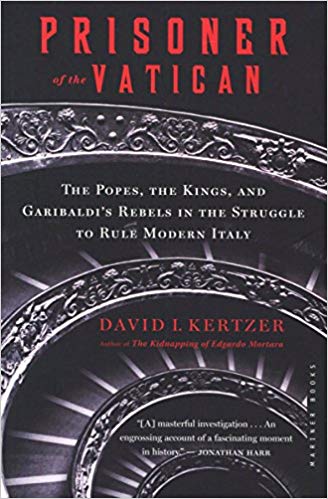
Prisoner of the Vatican: the Popes, the Kings and Garibaldi’s Rebels in the Struggle to Rule Modern Italy by David I. Kertzer.  This book surprised me as well.  Kertzer’s expertise is on the history of the Popes in the last two centuries.  This book tells the amazing story of how the Pope lost his country (the Papal States), but more importantly, how he moved from being a political and spiritual ruler to being a spiritual ruler only.  Also recommended – The Pope who would be King and The Pope and Mussolini by the same author.

2nd Tier reads – still very good and recommended
The Spy and the Traitor:  The Greatest Espionage Story of the Cold War by Ben MacIntyre
Frederick Douglass:  Prophet of Freedom by David W. Blight
Heirs of the Founders:  The Epic Rivalry of Henry Clay, John Calhoun and Daniel Webster, The Second Generation of American Giants by H. W. Brands
John Marshall:  The Man who made the Supreme Court by Richard Brookhiser
Spearhead:  An American Tank Gunner, His Enemy and a Collision of Lives in World War 2 by Adam Makos
American Moonshot:  John F. Kennedy and the Great Space Race by Douglas Brinkley
The Pioneers:  The Heroic Story of the Settlers who Brought the American Ideal West by David McCullough
The Cinderella Campaign:  First Canadian Army and the Battles for the Channel Ports by Mark Zuehlke
The Pope and Mussolini:  The Secret History of Pius XI and the Rise of Fascism in Europe by David I. Kertzer
Fire and Fortitude:  The US Army in the Pacific War, 1941-43 by John C. McManus
The Pope who Would be King:  The Exile of Pius IX and the Emergence of Modern Europe by David I. Kertzer
African Kaiser:  General Paul Von Lettow-Vorbeck and the Great War in Africa, 1914-1918 by Robert Gaudi
The Aleppo Codex:  In Pursuit of One of the World’s Most Coveted, Sacred and Mysterious Books by Matti Friedman
The Last Mughal:  The Fall of a Dynasty, Dehli, 1857 by William Dalrymple


3rd Tier reads – somewhat disappointing
Theodore Roosevelt for the Defense:  The Courtroom Battle to Save his Legacy by Dan Abrams and David Fisher
Edison by Edmund Morris
Spying on the South:  An Odyssey Across the American Divide by Tony Horowitz


Friday, August 16, 2019

From Foster to Adoption


This post should have been written a month ago, but life has been a bit crazy.  Please forgive the delay.

A year and a half ago I wrote a post about our decision to become foster parents.  While some of you know what came of that, others may not yet know.  So, here is the rest of the story up to this point.
Dawson, 5 months old

As I mentioned in my previous post, 5 month old baby “D” was placed in our home a couple days after we were licensed as foster parents.  Baby “D”, whose real name is Dawson, was an amazing baby.  He “fit” into our family immediately.  The only thing that was a struggle was he woke up every 2 hours or so crying and needing a bottle.  Or, so we thought at the time.  Later we discovered he had a digestion issue.

Dawson was in our home for 2 months before he was placed with some local family members.  His uncle and aunt lived at the time in Lolo and were willing to care for him.  Saying goodbye to the little guy was incredibly hard – Miriam and I were a wreck all day.  The only solace we had was that Dawson’ family had asked Miriam to babysit him a couple of days a week, so we still had some contact.

Dawson, Easter 2018
In the meantime, 2 other foster children, a sister and brother, were placed with us.  We cared for them for a couple of months until they were placed with some family.  At that time, we were notified that Dawson’s placement was not working out and that he would be put back into the foster system.  Would we be willing to take him again?  There was no hesitation – we said yes.  And so, at the end of March, 2018, Dawson was returned to live with us.

At the time when we applied for foster care, we were asked numerous times whether we were interested in adoption.  Each time we said no.  We had raised our children.  The last one was getting ready to leave the nest.  We were looking forward to having time for just the two of us.  And so adoption was not at all on our minds.  That is, until Dawson was returned to us.

Within days of his return and his folding back into our family as if he had never been gone, Miriam and I were quickly agreed that if Dawson was eligible to be adopted, we were willing to do that.  It was not what we had planned originally, but we are both still convinced it was and still is the right thing to do.  And so began 15 months of waiting.  Mom quickly terminated her parental rights.  Dad was sporadic in his visitation until he finally voluntarily terminated his rights in the spring of 2019.  That opened the door for us to apply to be Dawson’s adoptive parents.

Dawson, 26 months
And so, on July 17, 2019, we stood in front of a judge and formally welcomed Dawson David Boschmann into our family.  It is a bit of a terrifying responsibility, in that Miriam and I are no longer young parents, but we are trusting God that He is in charge and He has a good plan for this young man.  We love him dearly and are so glad that God brought him into our home that October a year and a half ago.  We thank you for all of you who have supported and prayer for this situation, and we pray that together we will be able to watch Dawson grow up to be a godly man of God.

Wednesday, August 14, 2019

An Encouraging and Challenging Journey


In the interest of full disclosure, the author of this book, Tara Barndt, is a personal friend of mine.  She asked me to provide a review for her book for Amazon, and I thought I would post it on my blog as well.  I have no problem writing a review for her because Tara has written a very personal yet insightful devotional on the Pauline epistle of Philippians.

Journey through Philippians is a 33 day daily devotional that takes the reader through Paul’s letter to the Christian believers in the Greek city of Philippi.  Each day’s reading concerns itself with only a handful of verses, allowing the reader to easily read, re-read and meditate on the day’s passage.  The daily reading is short – typically 2-4 pages – but not so short that it is lacking in content.  Tara does not shy away from digging into the text itself, at times tackling the original Greek meanings behind our English text, but she does so in a manner that is not at all overwhelming or intimidating to the average reader.

Tara’s writing is very honest.  As Tara’s friend and her pastor, I have seen her struggle with some of the very things she has put down on paper in this book.  She is not preaching at the reader from an ivory tower, convinced that she has it all together.  Rather, she is a fellow struggler, someone seeking to put Paul’s inspired words into practice in her life as well.  She uses an abundance of personal examples to help the reader understand and apply the day’s text and ends each day with a reflection section in which she invites each of us to ponder the text and its practical meaning for our lives.

Some of you may be concerned because Journey through Philippians is self-published.  While an increasing number of people are self-publishing today, many, including myself, regularly wonder about the quality of the typical self-published book.  Don’t worry about that with this book.  The author actually had offers from publishing houses, but her desire is to translate the book into Spanish and use it in ministry contexts in Central America.  Only by self-publishing does she retain the rights to the text to allow that to happen.

Journey through Philippians is an excellent study of Paul’s wonderful book.  I recommend it highly to anyone who is looking for a devotional that is both faithful to God’s word and seeks to challenge them in their walk with Jesus.

Thursday, March 14, 2019

Book Review - Love Thy Body by Nancy Pearcey


Have you ever wondered why society has so strongly rejected traditional morality?  Have you ever asked why people seem to think so differently than they thought even 20 years ago.  Nancy Pearcey, in her excellent book Love Thy Body:  Answering Hard Questions about Life and Sexuality, gives us the reasons why society has changed so radically.

Pearcey takes us back to people like Immanuel Kant, the 18th century philosopher who first taught that life is defined by a fact/values split.  Facts are public, objective and valid for all.  Values are private, subjective and relativistic.  The problem is, in our post-modern world, values have come to trump facts in every area.  When this fact/values split is applied to human life and sexuality, the facts of our biological body are set aside in favor of values that may or may not line up with our biological identity.  After laying this fact/values foundation, Pearcey goes on to painfully and exhaustively show how this idea works itself out in daily life.

For example, take the issue of abortion.  In the arena of abortion (and many other places), the fact/values dichotomy works itself out as a body/personhood contrast.  No one on either side of the abortion debate today denies that human life is present very early on in fetal development.  The baby inside a mother’s womb may be life, but post-modern society is quick to deny that it is a person.  Persons have moral worth and legal standing.  Bodies are expendable, biological organisms that can be sold for parts to the highest bidder.  Today being a member of the human race is not enough to qualify as a person.  Rather one must earn that status, something a child in the womb cannot do.       This lack of personhood provides the justification for abortion.

It does not take much thinking to see how this body/personhood split might affect the end of life as powerfully as it does the beginning of life.  Assisted suicide and euthanasia are driven by personhood.  In post-modern thinking, there comes a point when an aging or sick human being is no longer a person, but merely a body with no right to life.  Doctors are now people making moral decisions, not medical decisions.  And when life is no longer valued, the continuance of life comes down to a matter of costs and benefits, not any intrinsic value in that life.

The fact/values, body/personhood split also affects how we see and practice sex.  The hook-up culture that exists in our world is a classic example.  Our bodies are merely means of fulfilling physical needs that are to be divorced from our emotions.  Sex education in our schools is concerned with the health of our bodies, not the health of our hearts or emotions.  Sex becomes a religion, a vision of redemption.  It is also a lie, as human beings are designed to unite not only physically but also emotionally.

Pearcey also addresses Same Sex Attraction and transgender issues.  In these areas, identities are again driven by values, by our feelings and our desires.  Those “values” give us permission to use our bodies in ways that contradict biology.  The homosexual/transsexual/gender questioning person is convinced that their most authentic self can be found only when they reject the biological body given them by God and build their identity somewhere else.  Sexuality then becomes a social construct which is indefinable, able to be manipulated, fluid and severed from biological facts.  This, Pearcey explains, when taken to a logical conclusion, ultimately undermines the basis for human rights.

Finally, she addresses how marriage and family are affected by this change of thinking.  The assumption today is that marriage is no longer a covenant, but a contract defined by terms we choose.  In the Supreme Court’s Obergfell decision, the court reduced marriage to an emotional attachment which was identical to all couples, regardless of biology.  Redefining marriage leads to a redefinition of parenting as a contract as well; a contract an increasing number of parents are opting out of.  Here in Montana, 10 years ago there were just over 1000 children in the foster system, today there are 4000!  The end result is that the state ends up with power over families in ways that were unheard of 50 years ago.

All this is very depressing and worrying.  But Pearcey also has good words to say.  In each chapter, she is quick to remind the church of its response to these things.  Christians ought to be on the forefront of showing compassion to those who are sexually confused and struggling.  We need to communicate a high view of the body as God created it.  Yes it is corrupted by sin, but it also is of such high value that God will one day redeem it and make it new, fit for eternity.  We need to present a picture of a good God who is big enough to bring purpose to suffering and who can turn difficult events to something good.  We need to remind people that sex is not God.  Jesus Christ lived a fulfilled life, a perfect life, being fully human in every way, without sex.  We need to encourage people that our true identities are found in our creation in the image of God and that our biological identities have been given to us by God for good. 

Yes, we live in a very confused time.  But in the gospel and its hope for now and the future, God has given us wonderful truths to live out and to share.  We need to be diligent and see how these timeless, transformative truths can bring life and clarity to our confused world.


Thursday, March 7, 2019

Book Review: Holy Sexuality and the Gospel by Christopher Yuan


One of the great dilemmas we face as Christians is understanding and compassionately yet truthfully addressing the sexual challenges our society throws at us.  How do we respond to homosexuality, transgenderism, the redefinition of marriage and the deconstruction of gender, for example?  How do we find clarity in those things as Christians, as well as a way forward to lovingly address those issues with our family and friends, especially those who find themselves buying into these ideas?

Christopher Yuan, professor of Biblical Studies at Moody Bible Institute, has given us a great resource to begin to answer these questions in his book, Holy Sexuality and the Gospel:  Sex, Desire and Relationships Shaped by God’s Grand Story.  I was first exposed to Yuan’s testimony through his autobiographical book, Out of a Far Country: A Gay Son's Journey to God. A Broken Mother's Search for Hope.  I also had the privilege of hearing Yuan and his parents in person at the 2018 Montana Bible College Pastor and Leaders Conference.  The audio and video of those sessions can be found here.

Yuan’s primary premise can be summed up this way – my true identity is in Jesus Christ alone.  While society seeks to redefine sexuality and write gender off as a social construct, Yuan takes us back to God’s design as based in creation.  As he writes, “Clarity [in these issues] comes not by trying to decide which approach is more compassionate but by observing which approach is grounded in the correct version of truth – God’s truth.” (p. 4) 

The book addresses the broad span of human sexuality from a theological perspective.  He examines the issue of personhood.  Sexuality has become not how we are, but who we are.  No other sin is so closely linked to our identity.  Yet the question must be asked, does sexuality really describe who we are or does it explain how we are?  Can we define our identity and personhood by our thoughts and feelings, or is there an overarching identity given to humans by God?

Yuan does a great job taking us on a journey through God’s grand story of salvation.  He begins by examining the idea of the image of God.  He addresses the importance of the fall and original sin.  Often Christians are content to chalk the roots of homosexual behavior up to environment, but Yuan is very clear, “…to claim that the primary root of homosexuality is anything but original sin is to deny orthodoxy.” (p. 37)

The book then turns to focus on what God’s sexual ethic for human beings is.  It addresses desires and temptation.  The book unpacks what the Bible says about sexuality.  God’s sexual design for humans can be boiled down to a couple of biblical themes:  chastity in singleness and faithfulness in covenant marriage.  God’s standard for all is holiness – whether one is single or married.  Unfortunately, believers have not done a very good job of holding up God’s ethic in either of those areas.  Our theology of marriage tends to be muddled and incomplete, centered more on companionship or happiness or even the fulfillment of sexual desire rather than on marriage glorifying God and pointing to the ultimate reality found in Christ and his church.  Singleness has also not been handled well by the church.  While the single person is looked on with pity by some, Yuan makes a powerful case for the goodness of singleness and the fact that single person is just as able to glorify God and reflect a Christ-like identity as a married person.

The book’s last chapters address Christian growth and sanctification as well as providing some great, compassionate loving advice to those with friends and relatives suffering sexual confusion.  How can we love them and yet address biblical truth to their lives when we are given opportunities?  As a man who lived a homosexual lifestyle prior to faith, Yuan knows what approaches reflect Christ and which will not.  The bottom line for him and any other person we may know struggling with sexual identity issues is simple:  Jesus is better.  He is better than same sex attractions, singleness and marriage.  Identity found in him is better than anything found on earth in any sexual relationship.  When all of us understand that, our sexual thinking will begin to transform into something that truly is in line with God’s truth, will and desires.